

blog
Date Sugar vs. Brown Sugar vs. Coconut Sugar: Which Natural Sweetener Should You Choose?
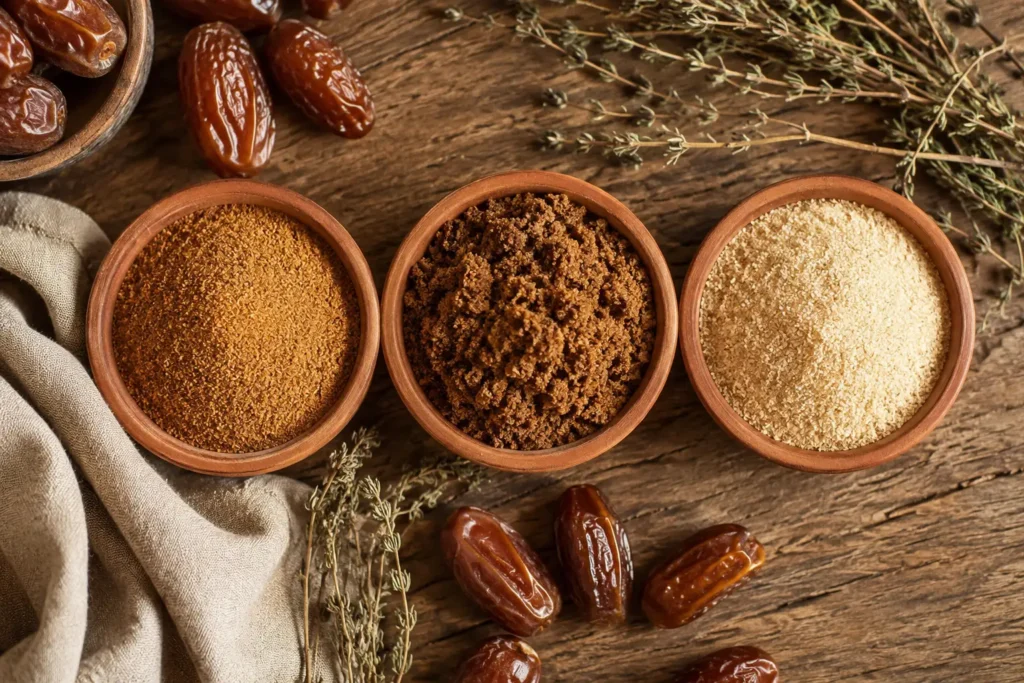
If you’ve been trying to cut back on refined white sugar, you’ve probably run into three popular “natural” alternatives on store shelves: date sugar, brown sugar, and coconut sugar. They look similar — all shades of brown, all sold as granules — but they come from completely different sources and behave differently in your kitchen. Here’s how they actually compare.
What Each Sweetener Actually Is
Brown sugar is refined white cane sugar with molasses added back in. It’s not a whole food — it’s processed sugar with a small amount of byproduct mixed in for color and flavor.
Coconut sugar is made by boiling down the sap collected from coconut palm flowers until it crystallizes. It’s less processed than white sugar, but it’s still a concentrated, extracted sweetener — not the coconut fruit itself.
Date sugar is different from both: it’s made simply by drying and grinding whole dates into a fine granule. Nothing is extracted, refined, or added — you’re eating the entire fruit, just dehydrated. Kartago Organic Date Sugar, for example, is made from Deglet Noor dates grown in the Djerid Oasis of Tunisia, ground with no additives at all.
Nutrition Comparison
| Brown Sugar | Coconut Sugar | Date Sugar | |
|---|---|---|---|
| Made from | Refined cane sugar + molasses | Coconut palm flower sap | Whole dried dates, ground |
| Processing level | Refined | Minimally processed | Unrefined (whole food) |
| Fiber content | None | Trace | Retains the fruit’s natural fiber |
| Vitamins & minerals | Negligible | Small amounts (potassium, iron, zinc) | Retains the dates’ natural nutrients |
| Glycemic index* | Similar to white sugar (high) | Reported lower by some sources, though estimates vary widely | Moderate — figures vary, but the fiber content slows sugar absorption |
| Dissolves in liquid | Yes | Yes | No — best used in baked goods |
*Glycemic index estimates for natural sweeteners vary significantly between studies and sources, and individual response can differ. None of these sweeteners should be considered a health food to consume freely — moderation still applies.
Where Each One Works Best
Brown sugar is the most versatile for texture — it keeps baked goods moist and adds a mild molasses flavor. But nutritionally, it offers nothing beyond what white sugar already provides.
Coconut sugar dissolves easily and substitutes 1:1 in most recipes, including drinks. Its lower glycemic index compared to table sugar is real, though modest — it’s not a dramatically different sugar experience.
Date sugar is the only one of the three that’s technically a whole food rather than an extracted sweetener. Because it’s just ground dates, it carries over the fiber and micronutrients naturally present in the fruit. The trade-off: it won’t dissolve in coffee, tea, or batters the way the other two do, so it shines in recipes where a bit of texture is welcome — cookies, granola, muffins, crumbles, and spice rubs — rather than in drinks.
How to Substitute Date Sugar in Your Recipes
Kartago Organic Date Sugar can replace cane sugar or brown sugar at a 1:1 ratio in most baking recipes. A few tips:
- Since it doesn’t melt like granulated sugar, expect a slightly grainier texture in the finished product — most bakers find this unnoticeable in cookies, muffins, and granola.
- It won’t dissolve in coffee, tea, or smoothies — for drinks, a liquid sweetener like date syrup works better.
- Its warm, caramel-like flavor pairs particularly well with cinnamon, oats, and nuts.
The Bottom Line
If your priority is convenience and a neutral taste, coconut sugar or brown sugar will feel the most familiar. But if you’re looking for the closest thing to sugar that’s still a whole, unrefined food — carrying the fiber and nutrients of the fruit it came from — date sugar is the only one of the three that qualifies.
Kartago’s Organic Date Sugar is made from Deglet Noor dates grown in Tunisia’s Djerid Oasis, cultivated by the Horchani family for nearly 200 years — the same dates behind our Organic Date Syrup. Shop Organic Date Sugar →
Frequently Asked Questions
Is date sugar the same as brown sugar? No. Brown sugar is refined cane sugar with molasses added back in. Date sugar is made from whole ground dates, with no refining or additives.
Can I substitute date sugar for brown sugar or coconut sugar 1:1? Yes, date sugar can generally replace either at a 1:1 ratio in baking. Keep in mind it won’t dissolve in liquids the way the other two do.
Which has a lower glycemic index: date sugar or coconut sugar? Estimates vary by source for both, and individual response differs. Coconut sugar is often marketed as lower-GI, but the difference from regular sugar is modest in most studies. Date sugar’s fiber content also slows sugar absorption compared to refined sweeteners.
Is date sugar healthier than brown sugar? Date sugar retains the whole fruit’s fiber and micronutrients, while brown sugar is essentially refined sugar with molasses. That said, all three are still sources of sugar and are best used in moderation.